



Over recent months, the Lord has put the question of Hell and its eternity on my mind. I was raised with very universalist ideas, such that Hell does not even exist in any ontological sense, but I confess I never really delved into the question after becoming a Christian of a more 'Biblical' type. Added to the prompting of the Holy Spirit, people had urged me to read That All Shall Be Saved by David Bentley Hart (DBH). As DBH clearly stated in his book, he would pull no punches. Allow me to also be rather bald about what I found. I came out of the book thinking DBH was way off mark.
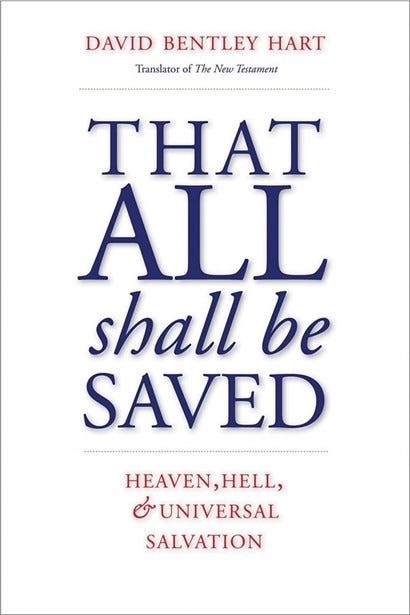
The first and most basic difference between myself and Hart are our divergent views on Biblical interpretation. As an absolute foundation to my own Biblical interpretation, the very first thing I consider is the interpretation of one verse in the context with other verses in the Biblical text, across both first and second testaments. For me, this is an utterly vital point based on the concept the Bible is God-breathed through those humans who wrote their particular texts. DBH is absolutely explicit when he says he does not accept the divine inspiration of the Biblical text and requires no internal consistency. By disavowing the need for any internal consistency, something I criticised in False Duality, DBH side steps any part of the Bible that disagrees with his pre-assumed positions. This one statement of the author torpedoed any credibility he would have had in my mind. It seems that many universalists need to take the same stance to support their theology on Hell.
David Bentley Hart quoted a whole tonne of scriptural references, much with the Koine Greek, which he said “appeared” to suggest an eternal Hell. He rather quaintly dismisses them as “hyperbole”, apparently quite ignorant of the fact the exact same could be said of his treasured “universalist” verses. This is especially so, given that we can throw out the need for internal consistency, according to DBH. Furthermore, DBH asks why Paul was not clearer about any limits to these so-called universalist verses which the apostle wrote. Again, the same question could be levelled at Jesus Himself. If the apparent eternity of worms and fire were mere psychological states, why didn’t He express that more explicitly? The simple reason: Jesus never meant it to be taken that way. And, in the context of the full canon of Scripture, neither did Paul.
The Defence
So, what is the take on Hell from a Biblical perspective which interprets the Bible holistically across writers and accepts the inerrancy of the Bible? I am going to accept the idea that the plainest meaning of the Biblical text is the most reliable, without discounting deeper meanings which preserve the clear meaning of the text. That is, except where metaphor and other devices are so painfully obvious, there is no room to debate them.
One of the most common words translated as “Hell” in the Bible is the Greek word γέεννα (Gehenna). Matthew uses this word extensively in his Gospel, as do Mark and Luke to lesser degrees. While the three writers agree on many points, each one adds a slightly different detail to to our understanding of Gehenna.
The word γέεννα comes from the Hebrew word “Ge-Hinnom”, which is a place just outside Jerusalem where children were sacrificed to the god Moloch. The idea that the valley was used as a constantly smouldering rubbish dump in Jesus’ time seems to have little evidence to back it up historically (any that I could find, anyway). However, the idea of a constantly burning rubbish dump is not necessary to argue for a particular set of associations and an understanding of γέεννα by people listening to Jesus. Just like the name Babylon today has certain, very strong connotations, even among some non-religious people and those in other faiths, γέεννα would have strong associations for first century Jews, especially those raised on the Torah and the Writings.
Gehenna is described in the Gospels as a place where people can be consigned after the body is destroyed (Luke 12:5) and Jesus radically states it is better to be maimed than to be consigned to Gehenna (Matthew 10:28; Mark 9:45-47). In the same verse, Matthew also records Jesus teaching the soul and the body are destroyed in Gehenna. The religious folk of Jesus’ time, according to Jesus Himself, are condemned to Gehenna for how they have made it hard for ordinary people to approach God and how they have treated the prophets of God (Matthew 23:33). Jesus was aiming that last at the religious hypocrites, and this only emphasises that religiosity will not help anyone avoid Gehenna.
What does the Bible tell us of this Gehenna place? Mark’s Gospel (Mark 9:44, 48) clearly states Gehenna’s fires will never go out. Mathew’s Gospel agrees with this (Matthew 18:8). Mark also adds a quote from Isaiah 66:24: “And they will go out and look on the dead bodies of those who rebelled against me; the worms that eat them will not die, the fire that burns them will not be quenched, and they will be loathsome to all mankind.” The symbolism of “worm” here is rich and goes beyond the idea of suffering. The worm is a clear symbol of decay - the decomposition of the body being the physical sign. Jesus, by quoting the prophet, is saying the process of decay and corruption will not end in Gehenna. There is no purification going on in Gehenna. Whatever corruption has condemned someone will remain with them for eternity. Therefore, the idea that Hell is temporary is not a teaching of Christ.
James, in his epistle, even uses the corruption of Hell and its evil to describe the work of the tongue in setting fire to people who do not control their tongues (James 3:1-12). James is drawing a connection between the vile suffering and evil of Gehenna and the way it works out in the world. A large part of Hell’s outworking is through people’s unrestrained use of their tongues, according to James. It is notable that James is talking about and to devout Christians in his epistle.
A phrase sometimes used to describe Gehenna is “eternal fire.” Jude gives a number of examples of those condemned to “eternal fire” and he describes their fate thus: “They serve as an example of those who suffer the punishment of eternal fire (v. 7).” The word Jude uses for “eternal” is “αιώνιος.” “Αιώνιος” means “indeterminate as to duration, eternal, everlasting (Mounce).” It is obviously not only the early Christian writers of our New Testament who believed that Hell is eternal, but it was also Jesus who repeatedly taught the same.
Returning to Matthew’s Gospel, in 25:46, it says (Jesus speaking): “Then they will go away to eternal punishment, but the righteous to eternal life.” Here, Jesus is basing His judgement on how Christians have responded to the poor and the marginalised. In both cases, the word “eternal” is the Greek word “αιώνιος.” Jesus is describing both punishment and life as being eternal. Jude uses the same word when he refers to “eterenal fire” (v. 7) and “eternal life” (v. 21). Therefore, if one holds Hell as a temporary state, one cannot believe in an eternal life. Either both are eternal or neither are. If we accept the idea of a limited, non-eternal Hell, we cannot hope for eternal life. At best, we might get a really long afterlife, but it will come to an end. To hold either punishment or life as eternal, but not the other, is patently abysmal interpretation and requires unreasonable mental gymnastics to uphold on a Biblical basis. Therefore, Hell is a place of eternal duration. The Bible has made that very clear.
Why Care?
Why does all this matter? What we believe about God and Jesus has important effects on our conduct as followers. Progressive Christians, in focusing on the “love aspect” of Christ (that “Buddy Jesus” always leaps to mind when I think of this), throw out an important part of His character and nature. That is, they throw out His justice and His adherence and clear statement that He did not abolish the Law of God. According to Jesus, God’s Law is eternal. By tossing those qualities of righteousness and justice of God out, Progressive Christians have a distorted understanding of God that is neither Biblical nor correct. And this distorted view has consequences in how Christians act and live. For example, many progressive Christians claim that all religious paths lead to God. It seems worshipping Allah, Moloch, Odin and countless others are equally valid paths to God. This is not what Jesus taught and God never said to the Israelites, “Don’t sweat it! The Asherah poles are a fine way to enter my Kingdom!”
God does not change. Jesus does not change. Therefore, for Christians who have a personal problem with God consigning the unrighteous to Hell for eternity, it is their problem. It is not God’s problem. Truth and justice are different aspects of love and they all exist in God perfectly.
In conclusion, what Bentley-Hart is teaching is heresy, to invoke an unpopular word for our time. I am and will remain an infernalist. Thanks for the category, David!
You can grab another of my book, NeoTokyo Dead, from all fantastic platforms!
